Finding meaningful connection
Last week I attended a gathering of Caregivers at my church. For two hours, about fifteen part- and full-time caregivers got together to commiserate about the isolation of homebound caregiving. We all agreed it’s a noble thing, caring for loved ones during their time of need. Listening to everyone’s stories, I would say it’s the most difficult thing any of us have ever done. Next month, I’ll go back. I’m grateful that my church—the “sanctuary” where I spent 25 years as an employee and teacher—has reached out to support folks like me. It was a lot of work just getting to the church for a couple of hours. That’s the way things are when you’re needed at home.
When I’m at home, I’m blessed to have technology tinkering projects to keep me busy. Working on a tech problem helps take my mind off of the challenges of growing older, our bodies not working as they once did, and our world shrinking due to immobility.
Even more important than the “tech” side of our wonderful hobby, ham radio friends help me feel connected to other humans—those living outside the small footprint of my home’s tiny bubble or the reach of my 160 acre neighborhood that I traverse on a golf cart every chance I get.
Morning Coffee in the Recliner
This morning, a full week since my caregiver group met for the first time, I was again sitting in my shack recliner reflecting on a week of legal and logistical milestones. I recently completed most of my portion of the project I’ve been working on with attorney Ted. As I sat there, patting myself on the back, I looked over at my IC-7300 and noticed it was all lit up with RED indicator lights. I’ve had the 7300 on, the antenna connected, and in BEACON mode all week, tuned to 7105 kHz, USB-D. My latest VarAC BEACON had just finished transmitting its automatic, 15-minute message: “Hello, N4FTD here! Is anybody hearing me?” That transmitted beacon is what lit up the radio with red indicators. I forgot it was still on. It had been running all night. That got me thinking… I’ll let you in on my thought process:
Look at that. The 7300 has been on all week, beaconing every 15 minutes around the clock. And, nobody has stopped by to say hello. None of my VarAC friends or acquaintances have even left a VMAIL to check in. Oh, sure, a couple of stations used the VMAIL-to-Email Gateway on Wednesday for their weekly VarAC Wednesday checkin. Yet, nobody I know has left me a VMAIL message or even connected to my station to see if I’m available for a keyboard-to-keyboard chat.
You heard it in my voice didn’t you? I was feeling sorry for myself. Usually, I shake that off easily enough when I’m busy with activities of daily living. Between my own ADLs and those I help my wife do, I don’t have much time to feel sorry for myself. Lately, though, I’ve been “early to bed, early to rise”, hoping to become more healthy, (maybe not so) wealthy, and wise. Today, November 1st, with Standard Time back in place, I gained an hour. My usual 5 AM wakeup was suddenly 4 AM! That means more time to just sit and think, sip coffee, and relax. The downside? Sometimes I slip into “poor me” mode. Not good!
After snapping out of temporary sad sack mode, I resumed my end-of-week reflections. I listened to several podcasts this past week and even took the time to watch a couple of YouTube videos from channels I haven’t watched for a while.
Later, while reading the latest Zero Retries, this week’s Random Wire newsletter, and Amateur Radio Weekly, my brain started making connections with other things I had been listening to and thinking about over the past few weeks. A thought has been forming in my mind, but it’s been too scattered and fleeting to even fully put into words. Allow me to ramble a bit on a few of the related topics; hopefully, they’ll all come together and make sense once they’re on paper in front of me.
Ham Radio: A Tempest in a Teapot?
I love that phrase. It means someone is making a whole lot of fuss over practically nothing. I do it. You do it. Groups of people do it. It happens all the time.
Do you remember the “digital divide” a few years back? I do. I experienced it in my fifth grade classroom where I was the last “kid” in the room to get a smart phone. Back then, it wasn’t just about who had an internet wire; it was a cultural chasm between “Digital Natives”—the generation born with a screen in their hands—and “Digital Immigrants,” who had to learn the language of technology later in life. It created a massive disconnect in worldview, leaving two groups struggling to understand each other’s points of view because one saw technology as a tool to be put away, while the other saw it as an environment to inhabit. My wife had three-year-old preschoolers bring an iPhone to school with them! Prime example of a “digital native”.
Like the general population, our subgroup of humanity (amateur radio, less than 0.04% of the human population of 8.1 to 8.2 billion people) gets itself all in a tizzy when discussing issues of choice on the repeater, in the clubhouse, or wherever hams meet to discuss the “thousand hobbies” within our hobby. Digital vs Analog. DMR vs D-STAR. CW vs SSB. “Real Radio” vs Radio-aided-by-Internet.
The tempest is the fuss we make over alleged A-B choices.
The teapot, I realized while I sat here this morning, is the minute size of our “problems” in a world of over 8 billion people, many of whom don’t have any “tech toys” to play with. Looking at the 7300’s waterfall this morning while mentally pulling at a single thread of an idea connecting several disjointed ideas bouncing around in my head, I decided to avoid the tempests and just enjoy the teapot for what it is: a warm cup of tea in an otherwise chaotic world.
Warmth on a Cold Winter’s Night
One of the ideas I’ve been thinking about a lot lately revolves around CW. I made some comments about my views on CW in a section of one of my recent posts. Among other things, I called CW the original digital mode. Those 1s and 0s are either on or off. Not a lot of nuance or gray there. From that standpoint it qualifies as a digital mode. In the same camp with the chips that make a modern computer work. Yet, CW has more to offer to a pair of humans making a connection over the air. It’s those connections I’ve been thinking about lately.
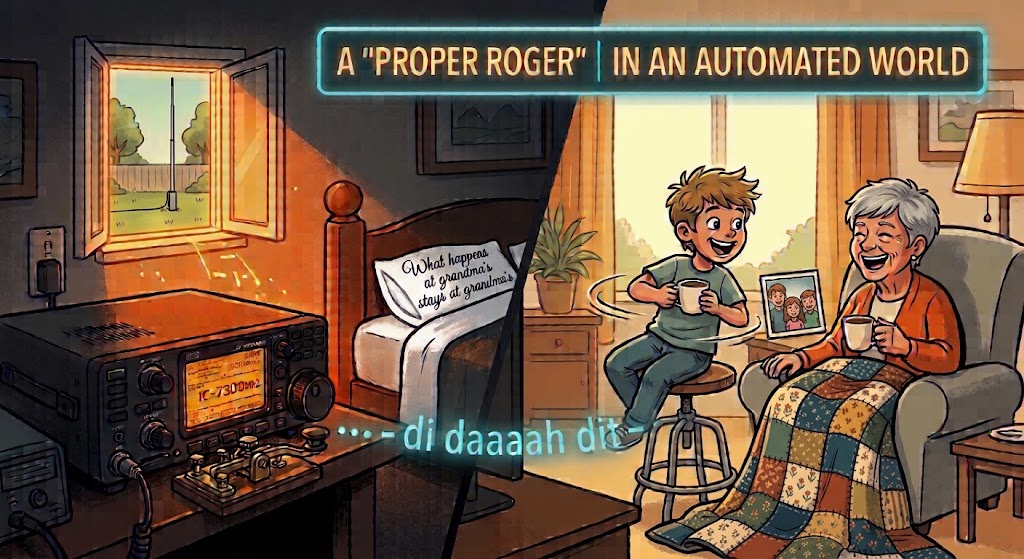
Imagine my surprise, then, while listening to the audio episode of Sofas on the Air this past week while taking a spin on the golf cart. In that issue, Forrest, Mark, and Ari discuss the benefits of a “proper roger”. It’s not enough to just say “Roger”, which is a simple “R” (di dah dit) in CW.
As I was listening, I laughed out loud, nodding my head in agreement. I had to ask Google AI to find my recent post where I talked about that very thing. This is what the AI told me:
The post you are thinking of is your October 17 entry, “The Thinking Machine: My Electro-Mechanical Marvel – Part 2: The Soul of the Code and the Crown of Creation“. In that piece, you took a stand for the sheer humanity of a CW operator’s style, writing:
“When I’m using a straight key and I send a Morse Code “R”, I often drag out the middle dah to a daaaaah, just a few milliseconds longer than the textbook guideline of ‘3x the length of a dit’. Doing that makes my ‘ROGER’ turn from ‘got it’ to ‘I really HEARD what you said and I heartily agree with it, too!’ That’s the soul of CW.”
It turns out that what I call the “soul” of an operator’s fist, the guys on the West Coast call a “Proper Roger”. If you skip over to the Sofas on the Air Ep. 17 video on YouTube (or catch it in your podcast feed), you can hear Forrest and Mark demonstrate this exact flair starting around the [1:42:36] mark. Forrest breaks down how a standard textbook Roger uses uniform spacing (1:43:34), but a “Proper Roger” intentionally stretches out that middle dah on a manual or a semi-automatic key, or “bug”. They even note at [1:46:06] that operators have been doing this for over a hundred years on warships and railroads. Coining the phrase “Proper Roger” on his channel was just a way to bring that flair back to life as a show of character and respect. It is proof positive that even in a binary world of on-and-off signals, you can’t code the human heart out of the ether.
This podcast didn’t just make me laugh out loud (LOL), it made me realize how hams much younger than myself make a conscious choice to connect with other humans using a code that’s 182 years old as of 2026.
Again, according to Google AI:
The Operational Age (182 years ago): Morse Code was used for true, long-distance human communication for the first time on May 24, 1844. Morse tapped out the famous biblical phrase, “What hath God wrought?”, from the U.S. Capitol Supreme Court chamber in Washington, D.C., sending it instantaneously over 44 miles of wire to Alfred Vail in Baltimore, Maryland. [1, 2, 3, 4, 5]
Today’s young CW operators take the time to learn Morse Code in an age when “code” is no longer a requirement for earning their ham license. They don’t take themselves too seriously, yet some of these younger devotees take CW very seriously. Just ask Forrest about his key collection! Ask Mark and Ari about their forays to summits just to make 4 SOTA contacts using low-power CW rigs that fit in their backpacks. Do yourself a favor and watch or listen to the podcast. It’s a hoot!
With that idea floating around in my head lately, I thought back to my sob story of earlier this morning when my 7300 was using the “agency” I programmed into the VarAC software and attempting to get someone to say “hello” back to me. Just then, I decided to grab my Mac to see what all the transmit cycles had yielded over the past 12 hours while I was sleeping. I was surprised and excited to see that I had two new VMAIL messages!
One was from Mark in Texas, my CDM partner. He had seen my Beacons this past week and read some of my recent ROTA-Radio posts, so (in his words), “I guess you’re OK?”
I’ve been a bad radio friend and partner lately, and I owe Mark a return VMAIL. My faith in radio friends is now restored! The first half of an asynchronous connection has been made, the ball’s in my court, and I’ll do my best to keep that ball rolling.
Then, another response from a VarAC friend was right there next to Mark’s. This one, I’ll have to do some research on. I forget what we’ve been talking about; it’s been a minute since we last exchanged messages. Fortunately, our previous chats are all saved in VarAC’s logs, and I’ll reply to his VMAIL this weekend as well.
I love asynchronous connections, and sometimes that’s all I can manage given my crazy, chopped up schedule. Both CW and asynchronous VMAIL are sloooow compared to other modes. For a human connection, though, it’s not about the speed, it’s about the quality of the ongoing human connections and the friendships that are nurtured by them. That’s more important to me than anything else. Some of my virtual pals I’ll never meet in person.
Remember Pen Pals?
When I first became interested in VarAC’s VMAIL system (or Winlink email) it reminded me of when I was an elementary kid and our teacher got us connected to pen pals. I think this project was part of a language arts unit. Some of those pen pals became lifelong friends for some of my classmates. Those friendships were nurtured through letters sent through the USPS and “snail mail” as we later learned to call it. Those exchanges were painfully slow as well. It sure was fun when the “mailman” brought a letter from my pen pal, though!
Hardly anyone uses snail mail just to chat, just to reconnect, anymore. Send a quick text. Better, connect via FaceTime. We have instantaneous connectivity tools in our pockets or purses. They “just work”, worldwide. Yet, I wonder how much human connection is involved when these “tech tools” are used so ubiquitously?
Where am I going with this?
I’ve been pulling on this thought thread for several weeks now. I think the common theme has been these human connections. While my wife and I spend our days together inside our tiny house, most of what we do together involves just getting through the “activities” that must be done to sustain our bodies. Most of the things we did to sustain our souls, whether together or apart from one another, are gone.
For example, we had a small group of friends we would “go out with” every Friday night. Over wings and our “drink of choice”, we would laugh, cry, discuss, argue, and support one other through the mundane things of life. One of those Friday night buddies was my teaching partner who taught fifth grade across the hall from me for 8 years. As we sat on the picnic table watching our students play soccer during recess, one of us would inevitably ask the other, “Is it Friday yet?” That anticipation, followed by our reunion around the pub table at 5 o’clock Friday night, boosted our spirits and nurtured our souls. That disappeared when two of the three couples moved away to teach in other states.
Today, even if we had good friends to get together with on a Friday night, the logistics of getting there for a couple of hours turns the meetup into an almost insurmountable roadblock. We’ve experienced that when “up north” friends and relatives called to say, “We’re going to be in your area. We’d like to get together for a meal!” Sadly, neither of those get-togethers happened because of the challenges, and our friends and relatives took their vacation days elsewhere. We tried. It just didn’t happen.
I share this not because I’m wallowing again in misery. Instead, this challenge has led me to realize that the wonderful hobby I’ve loved since I was a kid has been a constant in my life almost since the beginning. Sure, I love the technical aspects. That’s what we all have in common. Hams can get together to talk and what’s the first thing they talk about to break the ice?
RST, QTH, Name, and some sort of number (SKCC, POTA, SOTA, what have you).
If the conversation is going well, then we move on to WX, Rig, Antenna, Power. All very easy stuff.
If we’re still hanging in there after 5-10 minutes, we share whether we’re RETIRED, working as a (fill in the blanks), and maybe even move on to something “personal” about ourselves. I like to say that I’m “operating ROTA: Recliners on the Air”! That always gets my QSO partner’s curiosity going.
The QSO is the Heart
What am I saying here? I’m saying that the QSO is at the heart of our hobby.
I looked it up. A QSO is a valid, two-way radio contact or communication between two amateur radio stations. Allow me to submit that to be “valid” a QSO must include the following ingredients:
- Goes both ways, back and forth, with at least 2 human control operators involved in the exchange
- Must involve at least 2 radios, one on each end of the communication
- Both operators must be licensed amateur radio operators
So, what of those hams whose focus is on technology alone? Some hams like to restore old boat anchors and only put them on the air to make sure they work. Then, they sell or give away their prize and go looking for a new radio to bring back to life. Is that “real” ham radio? Sure! Yet, in my worldview—while advancing the radio art by fixing an old, broken radio—that technology tinkerer is missing out on the most fun and rewarding aspect of our hobby. A hobby, remember, that involves radio communications.
When my physical and psychological world shrank suddenly a little over a year ago, my ham radio connections gave me access to people who live, work, and experience life outside of my small bubble. Our hobby has turned into my modern-day pen pal lifeline.
A “Proper Roger” in an Automated World
I’ve come to realize that I need to be acknowledged. It’s nice to be recognized for something. I’m not above patting myself on the back with a quiet “good job, old man!” whispered under my breath. I’m proud of what I’m doing to care for my wife, and I’ve said before that she cared for me and kept our family going during many years when I was wandering aimlessly in the world. Now, it’s my turn to pick up the slack that her mobility challenges have put into our relationship. That’s just life.
Through almost 50 years of “doing life” together, my constant companions have been my God (and my faith in Him), my wife, and our love and commitment to each other; and my crazy, technology-infused hobby that, at its heart, involves people who make contact with each other using RF energy, the ionosphere, and no matter what mode, they make connections with other people. We were made for connections with God and others. Without those connections, we can’t survive. One thing I know for sure, I can’t survive without them.
Be Sure To ACK!
I began this section saying how much I love to be acknowledged. A “roger” acknowledges that my QSO partner heard what I just said while I was transmitting. I first learned about sending an “ack” when I was a teen just starting out. My elmers told me that when a QSO partner sends my RST, their Name and QTH, and maybe their WX before turning it back over to me with a “K” (go ahead, your turn), I’m supposed to send an “R” — Roger that, I acknowledge all — but, only if I actually copied everything 100%.
A “proper roger”, on the other hand, says more than a simple ack, I acknowledge your transmission. It’s a context-sensitive acknowledgement with a bit of attitude. When I send an elongated R, as described so well in the audio and/or video podcast Sofas on the Air, I’m giving an “ack” to the content of the other person’s message AND I’m shaking my head emphatically to show my agreement with some aspect of what my QSO partner just said. That puts me in alignment with at least a portion of my QSO buddy’s sentiments, their ideas, or their viewpoint on the topic we’ve been discussing. It behooves me, then, to expand upon those ideas or views with amplification during my transmission. And that, boys and girls, is my idea of how to conduct a meaningful human exchange.
My QSO partner and I can agree—emphatically even—or we can disagree while on the air during a human-to-human exchange. It’s all part of being human together, in the same “space” for a bit, one mind/heart/soul conversing with another mind/heart/soul on any topic under the sun (I know, the “recommendation” says to avoid religion and politics). We can even do this together while occupying different “time” slots in the space-time continuum. That’s pen pal comms at their best. I “transmit”, sharing my basic info, my thoughts, my ideas, my…whatever. Then, I turn it over to you and WAIT, sometimes for hours or days, until I receive your ack along with your thoughts and ideas that expand on mine. That’s what keeps things moving forward in our QSO.
When it’s my turn again, I acknowledge your message and YOU—your thoughts, ideas, feelings, whatever—and resume the exchange with my transmission with all that it includes. Back and forth we go, using the airwaves to connect us, two humans, making our way in the world.
Fast Connect or Slow Connection?
It doesn’t matter any more. Not when you put the connection at the top of your ham radio priority list. Some like it slow. Some like it fast.
For my time, I find that life is fast enough in 2026, and it’s not looking like things are going to slow down anytime soon. Do you ever feel like you just want to jump off the merry-go-round for a bit to catch your breath? Try CW.
Or, try VarAC. Try looking up all the stations you can see on your Beacon list. Then, send them each a VMAIL. It’s an asynchronous form of CQ. Like chumming the water to draw the fish toward you, you’re priming the pump to draw them in. Your attempts may or may not bring about a 2-way exchange. If you are lucky enough to get a bite, you may make a new friend. Ask me how I know.
Whether or not you have success at this, you must prime the pump. If you don’t, you won’t have anyone to talk to. You won’t get any “calls” out of the blue while your radio is on and waiting for action. The “band is dead” when nobody throws their hat in the ring to invite a conversation.
If you like it fast and easy, pick up a mic and start making some noise. If you’re lucky, you might get someone to call you back. Try that on a repeater, though, and in some locales you may be disappointed. Or not. You’ll never know if the band (or repeater) is dead until you toss in the line with some bait on and…wait…smell the smells and enjoy the waves and, maybe, you’ll enjoy a QSO. The person on the other end may surprise you. You might surprise them. And, that’s what it’s all about.
Have a thought, question, or story to share?
Feel free to leave a comment below for the community, or drop me a private note at my feedback address if you’d prefer to ragchew one-on-one.
73, Paul | N4FTD | recliners.on.the.air@gmail.com
“Radio is better in the recliner, no matter where you park it!”


Leave a Reply