Part 2: The Soul of the Code and the Crown of Creation
Previously on ROTA-Radio…
In Part 1, a tech futurist’s radical prediction that AI agents would soon make the World Wide Web obsolete sent my brain into high gear. While consulting Google AI Mode to navigate a frustrating battery crisis with my wife Sue’s wheelchair van, I hit upon a paradox: AI agents require the Web for fuel—if the Web dies, the agents starve. More importantly, I realized I don’t want a heartless software agent automating away my life’s choices. We left off on a weekend cliffhanger: my disabled van was sitting in the repair shop while I prepared to go toe-to-toe in a high-stakes, human-to-human trade negotiation on Monday morning…
The Trip Through An Automated World in My Thinking Machine
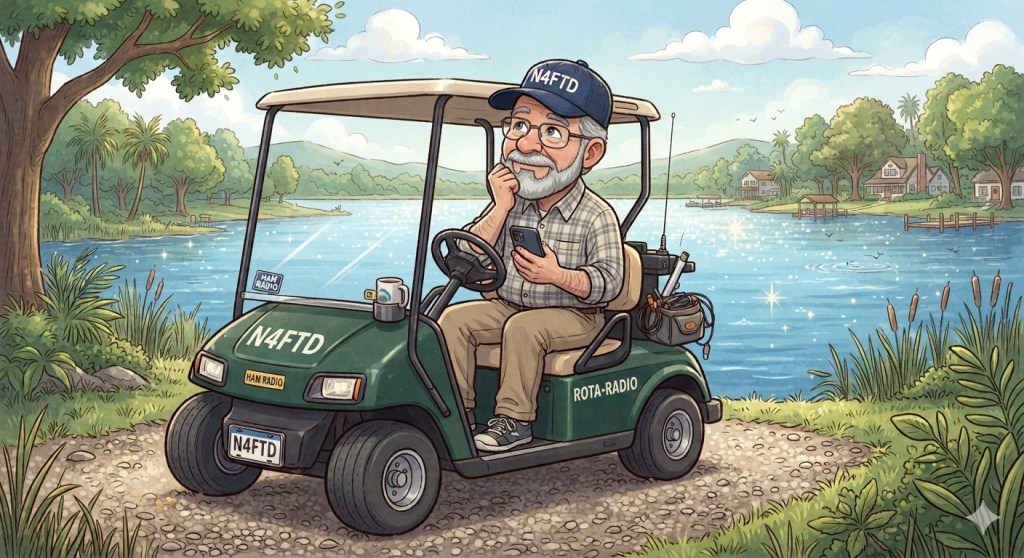
I’m leaving the recliner empty in my shack and heading out to the golf cart for a spin around my neighborhood. I try to make a loop every day. Starting from my carport, I turn left and head counter-clockwise around a 1 mile perimeter that takes me first to the neighborhood clubhouse. I come in from the rear across some grass and park near a dock that juts out into the lake. From my parking spot I can feel the gentle breeze blowing east to west across Lake Arrowhead. This time of year it’s hot and sticky, but that breeze makes it just bearable in the morning hours before the sun bakes everything and everyone who’s brave enough to venture out of their air-conditioned mobile home.
While sitting there, I usually sip on my coffee and take stock of my day. I let my mind wander, and usually within minutes something from yesterday or the past week causes me to start wondering, asking questions in my mind. Inevitably, I’ll reach for my iPhone and open a browser to Google search where I click on AI Mode.
One morning recently I was thinking about my finances—I’ve been poring over them lately while gathering documentation for my elder law attorney, Ted. From finances, I thought about how I’ve automated our income and spending on the monthly bills. I did that years ago. I set the payment parameters. Now, I only need to monitor automatic transactions as my money comes in and my bank or a vendor’s bank pushes or pulls it back out. What’s left over goes into the savings bucket. It works like clockwork. If one bucket runs low, I can perform a manual transfer and restore the balance sheet to its proper levels. I use computers and ACH bank transfers to my advantage. It’s a digital world, and I actively live in it while using its benefits to my advantage.
From there, my mind wandered to a video I came upon recently which was all about AI Agents. I began dipping my toes into the world of AI only in the past few months, and AI agent is a new term for me. I’m a relatively new user of Google Gemini and its cousin, Google’s AI Mode—a search engine on steroids. I haven’t tried any other AI tools from Google’s competitors like Open AI, Anthropic, or Microsoft. I read what others have to say about them through mostly ham radio publications like Zero Retries, Random Wire newsletter, or Etherham, but I haven’t tried any of them myself.
With my iPhone now in my hand while looking out over the water, I asked Google’s AI Mode, “What’s an AI agent?” From there, we began talking about the YouTube video I had watched. It was all about AI agents and how they’re going to make the Web obsolete. Instead of “Googling it” to find a list of websites, we’ll be asking our AI Agents to find solutions to our problems, go online to find vendors who can sell us what we need to solve those problems, then my Agent will work with the supplier’s Agent to complete a transaction over the Internet that results in me buying what I need. The alleged benefit of AI Agents? I won’t have to do any of that routine stuff myself. My AI Agent will do it for me.
CW: My First Human Interface On the Air
As often happens when I’m chatting with my AI helper about one thing, one thought leads to another. This time, I jumped from AI Agents to CW—the first “digital mode” for ham radio and the first mode I used as a ham operator. I’ve read books about the origins of CW. I began my ham radio journey as a Novice, with a license that allowed me to communicate on-air using only CW. I grew to love it as a teenager, and I still do today as a “senior citizen” in the early 70s.
Through my participation in CWI—CW Innovations—I finally broke my speed bump of 18 words per minute, which led to a renewed love of the mode. In our class, we talked about what makes CW so different from all the other modes, from SSB to digital HF modes, to all the new things we can do with VHF and above using computers connected to our radios. CW is a simple mode.
In my conversation that morning by the lake, Google’s AI shared that long before Bill Gates or Steve Jobs or any of the other computer pioneers built a personal computer, ham radio operators and the wireline telegraphers who came before them were already using fast-switching, on-off circuits to connect human minds and hearts. Unlike the pure and perfect binary ones and zeros that make up the circuits inside a computer, server, or data center, CW has a soul. Let me explain.
First, let’s talk about the ones and the zeros, the on-off circuits that make up a computer’s binary “brain”. CW also has an on-off circuit. A simple straight key is, literally, a normally-open switch. A “brass pounding” CW operator closes the switch when pressing the key, known in CW circles as pounding brass. Yet, there are more than just two states. While a computer only has a binary “open” or “closed” circuit—off, on—CW has three states with shades of grey between them.
When I pound my key with a quick tap, that’s a dit. When I pound and hold briefly—roughly 3x longer than I would hold the key down for a dit—I’m making a dah. Dit-Dah, then wait a fraction of a second with the key/switch open, that’s a space. It’s also a zero in computer-speak. A dit or a dah is a closed circuit—the RF power is on and my signal goes out over the air. The space between characters is an open circuit, the RF power is off, and that dead air also goes out over the air! Operators who (in these times of no-code licensing) voluntarily subject themselves to the rigor of learning the code—the Morse Code, specifically—will eventually not only learn an alphabet, they’ll soon be able to master the code in a way that their mind will be able to connect wirelessly to the mind of another operator at the far end of a QSO.
There’s a BONUS to operating CW in the modern digital age. It’s painfully slow compared to the speed of a computer. For me, that’s a significant benefit. Rather than a bug, it’s a feature of CW. If “less is more” at times, then when your life is racing at breakneck speed to meet a boatload of deadlines, slower is better—much better—even if only for a little while as you’re enjoying a CW QSO. That’s where the soul of CW enters in. Sounds counter-intuitive doesn’t it?
These days, I jump on my golf cart and head to the very spot you and I are sitting right now while the mic (or key, or keyboard) is in my hands. I’m on my golf cart so I can stop the breakneck speed of my life and just sit here, smelling the breeze, letting my mind wander, and—if only for a few minutes—jump off the treadmill of my overly busy life. You’re right here with me, since you’re reading my “mind”.
When I finally find time to play with my radios—hidden somewhere under a pile of legal paperwork—sometimes I just want a lazy, focused, mind-to-mind conversation with another human being who loves the hobby, and the mode we’re using, as much as I do. It’s not about the tech so much as the connection between code buddies. Soon, all the distractions of life melt into the ether as I stretch my mind to pick out the dits, dahs, and the dead air spaces between them. I’m super-focused on my buddy and his “fist”. And, on what he or she is saying.
I have CW friends whose unique way of sending code I recognize immediately, and I consider it a point of pride that my unique “fist” is also recognizable to my friends. Rather than a cold, sterile, digital on-off in rapid succession like my computer is known for, my “fist” has a soul. My ON, when RF signals are racing at the speed of light from my antenna to my code buddy’s antenna, has a certain character. Sometimes, it’s a staccato di di di di dit—a Morse Code “5”. Next, it’s a di daaaah dit. “R”. Roger that! I heard what you just said and, boy, did I understand it! “I hear dat, ‘old buddy!”. When I’m using a straight key and I send a Morse Code “R”, I often drag out the middle dah to a daaaaah, just a few milliseconds longer than the textbook guideline of “3x the length of a dit”. Doing that makes my “ROGER” turn from “got it” to “I really HEARD what you said and I heartily agree with it, too!” That’s the soul of CW. The first digital mode.
Yes, you can also do that with the tone of your voice on SSB. Anybody can do that. Just talk. The inflection in your voice, the amplitude, the speed. Like “a picture is worth 1000 words”, your voice expresses your emotion over the air. Enjoyed SSB when I first earned my General ticket. It was something new, and I had waited a decade for the privilege. Now?
I like digital modes. I use digital modes in my living room recliner while Sue is taking a nap, watching TV, scrolling on her iPhone, or spending money on Amazon. She likes me nearby while we “parallel play”, and I like it too. But, I’m not gonna be rude and talk on the radio while she’s trying to chat with one of our grandkids via FaceTime. I could just go into the Shack, but I like being present with my wife. Pounding brass while Sue is close by? Her super-sensitive sense of hearing only hears a series of annoying clicks on that normally open switch. So, I save CW for the shack or my golf cart.
Yes, I also chat with my code buddies or my digital mode friends using VarAC or PSK-31. I use those modes when I’m in the recliner while keeping a light touch on the keyboard for Sue’s sake. Most of the time these days I operate digi-modes using my remote Tailscale and RDP connection—a remote laptop connected to the shack computer. Computer-aided digital modes are my second-favorite way of having a conversation with a buddy over the radio, whether from the recliner, the shack, or the golf cart. Lately, the only reason I keep my hand mic plugged into my IC-7300 is so I can press its PTT button to tune my antenna system when I change bands.
Yet, as we sit here and stare at the lake, this sidetrip into the joys of CW explains why an accomplished, practiced, CW operator feels like he can’t get enough of “pounding brass”. When I press the key, I’m doing the exact same physical action as a computer transistor. I’m manipulating a high-voltage circuit, flipping it on and off in a binary pattern of ones and zeros.
Yet, along with my code buddy on the other end of an RF circuit that’s likely bouncing off the ionosphere once or twice between us, those binary ones and zeros are serving as a high-fidelity bridge between two eternal human souls. When I pound my key with heart and soul on my end, my buddy picks up on the emotion, the shared history, and together we share a deep personal connection in a way that no computer can duplicate.
I’ve had similar exchanges using VarAC, where my personality shines through because of the way I word things. Some of those QSOs drag on over days and weeks, asynchronously. I’ve used VarAC’s automated features to pick up VMAIL messages from my friends while I was sleeping or otherwise involved in doing other things. That’s great. And convenient. I can do it in my sleep! Yet, it’s not the same as two human minds connecting during a live QSO.
CW proves that binary code doesn’t have to be cold, automated, or “frictionless”. In the hands of a human master, the simple on-off circuit becomes the ultimate instrument of presence. That’s what I’m all about when I participate in our great hobby with like-minded hams.
So, sitting here on top of the 5kW powerhouse under my golf cart seat, I’m thinking about the wonders of technology—basic electricity and electronics—and radio in particular—then my mind finally gets back to the AI chat that started me down this CW rabbit hole. AI Agents.
The Agent In Charge At My QTH
Who’s the Control Operator?
The tech world’s new thing, in contrast to my CW straight key that has heart and soul, is rigid and heartless, a frictionless binary with an automated software circuit that wants to rob me of my human negotiation with Mike the van salesman. I can’t trust an AI agent to give Mike the benefit of the doubt when his focus on selling causes him to lose sight of the repair job he’s facilitating for me in the shop behind his sales office.
I’m certainly not going to trust Mike’s heartless Agent to take my human story of Sue’s inability to just get out of her wheelchair and crawl out of the van when she’s trapped inside on a hot Florida day with a dead battery and no way for me to get her out. I want humans to work through every negotiation that takes place between Mike and me. I know he cares about his customers and the safety of their handicapped loved ones. I care about him and want him to make a fair commission on the sale of a replacement van for Sue. I’ve been in sales, so I know the drill. Together, we’ll either work out a mutually-beneficial “deal” or we won’t, but we’ll do it together as humans with hearts.
Friction? Who Needs Friction?
Speaking of the frictionless society that the proponents of AI agents predict and promote. As much as I love my automated bill-paying system that has worked without a hitch 99% of the time since I implemented it, powered by computers talking to computers, I don’t want my human interactions automated and frictionless. I could list dozens of examples where I use asynchronous, computer-to-computer automations to communicate with radio friends, pay my bills, tell me when it’s time to take the clothes out of the washer and toss them into the dryer, and more.
There comes a point, however, when I—the human in the room—just have to draw the line. I think that line, for me, probably becomes important in situations where my human agency is needed. My human decision-making is “good enough”, maybe even superior to the agency that AI model trainers want to build into the upcoming AI agents.
That futurist who predicted that AI agents will make the Web obsolete forgot one important thing. AI agents rely on the Web as their communications channel. It connects them to other AI agents. If the Web is gone, AI agents have no way to get things done. Yes, I know that the World Wide Web of interconnected “compute” black boxes—computers and servers—could take over the Web and maximize its utility without all those pesky humans looking up videos of cats. I’m just not so sure that’s a tech-enabled world I want to live in. While that’s coming from a 71 year old, I’m fairly tech-savvy and consider myself an accomplished tech nerd on several fronts.
It’s just that I’m a proponent of having a thicker line drawn between what humans do—fairly well, thank you very much—and what we can program computers and AI to do on our behalf. And, I almost forgot about that friction. AI agents promise frictionless transactions in exchange when humans give away their agency to an AI by programming instructions into the AI computers. Why is that a bad thing?
In the world God made—and I’ll come to God in a minute—friction was built in as a feature with benefits from the Beginning, right alongside gravity. There must be a reason why those physical ingredients were sprinkled into the batter when God said, “Let there be light. And there was light. And it was all good.” (paraphrased from Genesis 1 and 2 in the Judeo-Christian Bible).
Why Gravity and Friction Were Created
Sitting here (literally now) on my golf cart seat in the hot summer sun with ambient temperatures FINALLY in only the 70s (76 dF) with a breeze that makes it feel closer to 74 or 75—my kinda Florida WX!—I’m thinking back to the seventeen years from 2001-2018 when every year my fifth graders and I would trek across Florida to the Kennedy Space Center for our annual Space Camp experience. Our experience together lasted roughly 48 hours, door to door. It was what we called a culminating experience following a multi-week science unit on Motion and Energy. Book learning in the classroom, sprinkled with little micro experiments and motion demos followed by a trip to the Space Center to see up close and personal all the stuff I had been sharing with my 20-25 students for the past several weeks.
I loved those trips. We slept in sleeping bags under a real Saturn V rocket the first few years. Very cool! For an older guy who wakes up at least once each night to pee, imagine waking up, looking straight up, and seeing a giant tube—one stage of a 300+ foot tall multi-stage rocket that overcame GRAVITY and FRICTION and INERTIA (bonus lesson) to carry 3 astronauts in their little mobile pod safely to the Moon and back. In the 1970s, no less. Awesome!
Later, after the Shuttle Program ended in 2011 and the powers that be had a chance to do their human-to-human negotiations, the Shuttle Atlantis—one of the fleet that my teaching partner Kathy and I had seen up close and personal a year beforehand when it was being prepped inside the VAB (Vehicle Assembly Building) after its trip back home to Florida. We had previously seen it on the launch pad during a bus trip around the hidden recesses of the KSC with an earlier group of fifth graders.
The next year, we noticed that they had built a new building on the KSC campus, and they built it around the newly mounted Shuttle Atlantis, hanging from the building’s ceiling (so it appeared) as if it was gliding home to land on the 3-mile long strip of asphalt that we had also seen with our own eyes on that bus tour a year or two earlier. We were privileged to sleep underneath the Atlantis two or three times before my 17-year stint in that fifth grade classroom came to an end in June of the 2018-2019 school year.
It’s a good thing God built friction, gravity, and inertia. Without those ingredients, the Shuttle Program would never have gotten off the ground, much less been able to orbit the Earth, without any “gas” in the tank going 31,500 mph using mostly inertia and gravity to keep it in orbit. Later, friction slowed things down as the Shuttle slowed its orbital speed just enough so that it would slowly descend toward the Earth, using friction between the wings and the atmosphere on the underside of the Shuttle to bring the astronauts safely to the exact spot where that 3-mile long landing strip was waiting with—you guessed it—more friction to bring the Shuttle to a stop before 3 miles of asphalt ran out beneath them.
I’m tickled that God made friction. It keeps my wife Sue from sliding all over the wood floor—in her wheelchair now, but earlier in her shoes with a walker when neuropathy prevented her from feeling the floor beneath her. Friction kept her from slipping and sliding and falling—something you don’t want to happen when you’re 70 and your bones are old and brittle. Friction is wonderful in the right context! It’s critical for getting around on Planet Earth!
When I automate my finances, I minimize the friction of monthly transactions and they happen automatically. When I carry on a month-long asynchronous QSO with a friend in Delaware who’s using his remote HF rig in Canada where he runs a VarAC station 24/7/365? He’s a super cool ham buddy with lots of stories to share with me, and vice-versa. When we chat slowly in short bursts over weeks back and forth, our QSO is frictionless as long as his remote station is up and running. I wouldn’t have it any other way in the middle of the night while I’m sleeping, which is when we often exchange messages, aided by our computers.
When I’m the principal of a small, rural, parochial school and carry on YEAR-long 15-second exchanges in an ongoing conversation with the parent of one of our students—in the carline at the end of each day—it’s the HUMAN touch that makes both the parent and me feel like we’re on the same page together as we pass the baton (their child) at 3 PM and 8 AM every day for 180 days during the school year. Friction is just part of being human in that scenario and use case. Time, in that case, provides the friction and slows things down quite a bit. It takes a whole school year to get to know each other when you “connect” only in the carline!
I refuse to farm out my relationships when they involve humans and their needs. I’m not going to delegate those conversations to an AI agent who promises “the moon” to me!
Whew! With that under my belt and into your head, it’s time to move to my other favorite golf cart parking spot where there’s some shade. It’s still 76dF in the sun, but the breeze has slowed down and the heat of the sun has heated up both my laptop and my tethered iPhone, not to mention my legs and arms. I’m starting to sweat, so it’s time to fire up the cart and head to the shade tree.
Under the Shade Tree
There, much better. Not much breeze, but the shade more than compensates. I’m cool. I’m comfortable. I’m ready to land this post and finish the trip in my Thinking Machine. That’s what I’ve started to call my golf cart because it seems every time I take a spin around the block, my creative juices and my imagination start to run wild. Sitting on top of 5kW of power, I can plug in my iPhone and laptop and hammer away on the keyboard. This winter will be a lot better when it’s 60 degrees and I’m wearing a hoodie instead of dodging old Sol’s rays! Eventually, I’ll do some POTA Hunting from the golf cart or have some CW ragchew skeds while I’m parked, staring at the lake.
Human Agency, Higher Authority
I promised earlier to explain how God fits in my thinking about AI in an automated world. I’ve shared before how God plays into my worldview and my thinking. I spend a lot of my time thinking—mostly while I’m riding around on my golf cart. In this final section I’ll share why I’ve expressed some fairly strong ideas in this post and throughout my ROTA-Radio space on the Web.
I always start with Genesis, often called the Book of Beginnings. I grew up believing in a God who Created human beings and declared them—and the created world they inhabited—“good”. I was taught, and I shared with my fifth graders, that good in this context meant everything was perfect. Until it wasn’t. The first 3 chapters of Genesis tell the before-and-after story, so I won’t quote it in this space. Feel free to look it up if you like. It reminds me a lot of some stories about people and God in the 21st Century and how people get along with each other (or not) today.
Instead, let me simply say that I believe the story in Genesis. I can’t begin to imagine what it was like to be perfect, living in a perfect world, communicating and cohabitating with a perfect spouse, and strolling through a perfect garden while talking to the Creator who made me.
I’m not perfect. The world isn’t. Nobody is. It’s the only world, the only reality, I’ve ever known. “Nobody’s perfect” is a phrase we’ve probably all heard at least once in our lifetimes. Everyone seems to agree on that basic fact.
The Genesis story says that the first humans were tempted by the devil, disguised as a snake, to grab more than what God gave them. He gave them all that they needed to sustain their lives and livelihood in that garden where, I’ve later learned through some research, the weather was more reliable than what we have here in southwest Florida in the almost-Fall while sitting on my golf cart in the shade.
Whether it sounds like a far-fetched story or not—a human talking to a talking snake—the snake in Genesis tempted the humans to disobey the Creator’s only command: You may eat from any tree in the garden except for this one, the Tree of Knowledge of Good AND Evil. Those two words have always made me wonder: where did evil come from in an otherwise perfect world? Why not let the first humans be aware of evil so they could steer away from it and remain Good?
The point is, they gave in to the temptation, they refused to take NO for an answer, and they ate the forbidden fruit. Suddenly, everything changed. The way I think of it, humans became less than human from that moment on. The Creator made humans good—and now they did something bad. Perfection was spoiled. By definition, they were no longer perfect. They ruined their relationship with the Creator, with each other—they blamed one another for giving in to temptation—and with the world. Things suddenly went from “paradise” to hell on earth, one problem at a time.
It doesn’t take a rocket scientist to see that the world we live in, and all the people in it—present company included—are imperfect. You don’t have to turn on the evening news to see it. If you do watch the evening news, you’ll see satellite images, stories from near and far, that illustrate just how far we humans—and the world we do such a poor job of managing—have strayed from what the Creator created. We’re hard-pressed to describe it as “perfect”, much less “good”.
So, as I sit on my golf cart I’m remembering how the Creator treated the first humans as “the crown of His Creation”. Humans were placed at the top of the metaphorical food chain and given the job of naming all the animals and managing the Earth. I think the command, or job description, was to subdue the Earth.
Where are we now? The Creator crowned humans with agency—a unique ability and a role to go with it—because we can think and decide for ourselves. We can even decide to do evil. I’m not so sure that was a good idea—to create humans with the ability to rebel and to disobey the Creator. But, what’s the alternative? Create a bunch of robots?
I’m happy to be human, but I was born less than human by the definition I’m using. Ever since Genesis 3 it’s been that way for humans. My imperfection wasn’t the Creator’s plan for humanity. Somehow, I seem to have inherited it. Maybe it’s in my DNA? Who knows. Yet, there’s no way I’m going to give up my agency, intellect, or the purpose I find in my caregiving. I’m not handing any of these uniquely human attributes over to an AI agent.
As I sit here on a powerful power plant buried under my seat, I’m looking up at the blue sky filled with puffy white clouds that just hang there, defying gravity. That scene always reminds me that there’s a Creator who loves me and puts up with my stubbornness—a Creator who is greater than me and Who reserves the final, ultimate, sovereign authority for Himself. That’s my worldview. Yet, I still have agency, free will to think and act for myself. I’m not going to squander that on a data center that runs on cold, lightning-fast, 1s and 0s with no humanity at all.
It gives me great peace of mind, knowing that I don’t control everything. That’s too much responsibility for one human, even for the whole human population. Every created being that occupies this universe—and for our purposes, this Earth—has been given a specific role and responsibility.
My specific role and my personality led me to become a nerdy radio-computer fan. Today, my main job is to be the sole caregiver for my wife. I landed that job for a reason: I’m the most qualified human on the planet, and I have a resume to prove it. I plan to spend the rest of my days on Earth in the service of these few activities and the people in my orbital circle. Mostly, that’s my wife of 49 years.
Earlier, I said my life has been a journey, and the destination is already pinned on my life map. It was put there when I was born. The road keeps forking, twisting, turning, doubling back on itself, often unexpectedly. I can’t recall ever being tempted to just park it and quit. I keep going, like a shark swimming through water so it can breathe, I keep going. The destination is a given. It’s just a matter of time before I get there. I’m closer today than I was yesterday, but I’m in no hurry, as Kenny Chesney sings in his song about heaven. I have work to do while I’m still traveling this Earth.
The Rest of the Story
Speaking of being in no hurry, that brings us back to that high-stakes, human-to-human Monday negotiation I left you hanging with last week. I sent a counter-offer via email, armed with my AI-assisted talking points, hoping Mike and I could find a win-win number we both agreed on. While Mike was as open and helpful as ever, his boss, Tom, apparently wanted a bit more profit out of the trade than I was willing to surrender to him. As the human holding the keys and the ultimate agency, I exercised my right to walk away from a bad deal.
So, the search for the perfect side-entry Honda or Toyota is still on. But meanwhile, we have a safe van sitting in the driveway with a fresh pair of batteries, completely fixed and working beautifully. We fought the real-world friction, and we came out on top.
I’m glad you’re here traveling with me, and I hope you’ll share a bit of your story, too, by accepting the invitation below.
Either way, whether or not you decide to share, I’ll be here again next week.
Have a thought, question, or story to share?
Feel free to leave a comment below for the community, or drop me a private note at my feedback address if you’d prefer to ragchew one-on-one.
73, Paul | N4FTD | recliners.on.the.air@gmail.com
“Radio is better in the recliner, no matter where you park it!”



Leave a Reply