Every week when Zero Retries by Steve Stroh and Random Wire by Tom Salzer drop into my inbox, two things happen simultaneously:
First, I catch their enthusiasm. Both Steve and Tom write with a passionate, infectious drive for the technical frontier of amateur radio. They get my gears turning, spark my “Thinking Machine,” and make me want to reach for a radio or boot up a fresh VarAC session.
Second, a memory from decades ago quietly tugs at my sleeve.
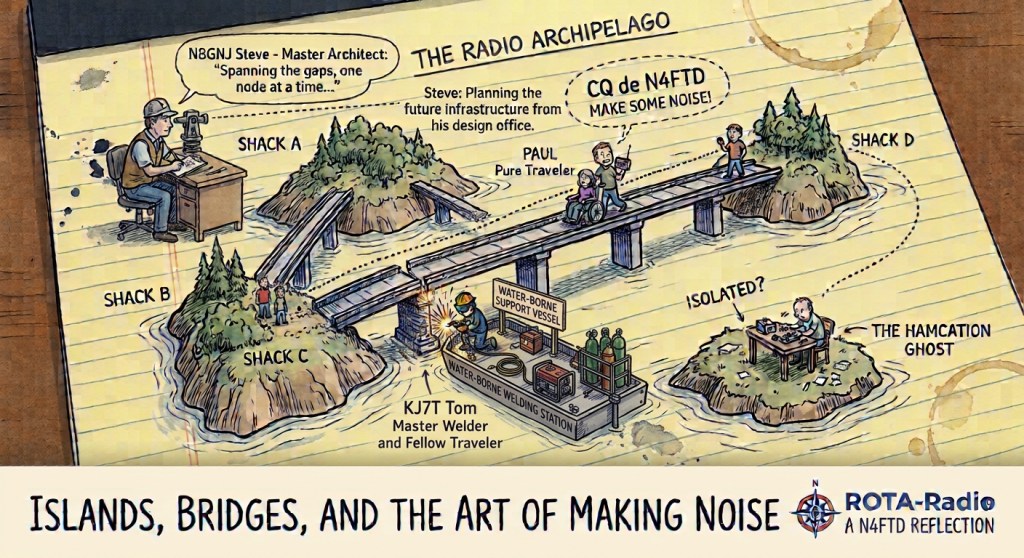
Back in the late 1980s, while leading a church study group near Orlando, I drew a series of isolated islands on a whiteboard—separate points representing distinct ideas. We were discussing how to share with others, how to connect one aspect of our faith to the next in a coherent story. After class, while clearing away coffee cups, I found a legal pad left behind by one of the participants. On it, they had drawn my sketch, but added something crucial: clear, sturdy bridges connecting every single isolated island.
That image of Islands and Bridges has stayed with me for forty years, and it perfectly captures how I view our hobby today.
The Landscape of the Shack
In our world, the Islands are us—the individual operators sitting in our shacks, separated by miles, time zones, or life’s daily demands.
The Bridges are the gear: the radios, packet networks, wire antennas, digital codecs, and software interfaces built to span the gulf between us.
And then we have the Builders. But even among my technical mentors, there’s a key distinction:
- Steve is the Architect and Cheerleader. He stands up on the scaffolding, sketching out master plans for the digital future, calling our attention to new protocols, and inspiring thousands of us with his writing. Yet, as he candidly admits, the sheer weight of chronicling the hobby sometimes keeps him locked in the planning office, unable to step onto the very bridges he writes about.
- Tom is the Master Welder and Fellow Traveler. He’s down in the structural steel getting his hands dirty with node builds and code, but he routinely climbs up onto the deck, walks across to neighboring islands, and spends quality time listening to the conversations taking place over the air.
Without the builders and maintainers, our bridges would collapse into the sea, leaving us entirely disconnected. We owe them immense gratitude for keeping the infrastructure alive. That’s why every weekend I devote significant time to reading Zero Retries, Random Wire, and Tom’s companion Etherham, along with my favorite curated collection of ham radio news and ideas, Ham Radio Weekly.
Walking the Span
But there’s a flip side to getting absorbed in the mechanics of the bridge.
When an entire sub-culture of radio gets hyper-focused on protocol specs, packet framing, and link handshakes inside a lab—work that is vital to moving us forward—we run into a strange paradox. In the quest for zero dropped packets, we end up with infinite retries—a technical marvel that executes flawless handshakes, but delivers zero actual human conversation.
It reminds me of a guy I saw years ago while walking among the used gear tables at Orlando HamCation. Over in the corner, an older ham sat all by himself, sending code with a gorgeous fist. But he wasn’t plugged into a rig, and he wasn’t sending on the airwaves. He was just tapping code into the open air of the room. Perfect code, absolute mastery of the instrument, but talking to nobody.
We forget that a bridge isn’t built just to be welded or marvelled at on paper. It’s built to be walked on.
I am not a welder. Once a wire antenna is tuned, my technical expertise pretty much caps out, and I become an appliance operator. I am a pure Traveler.
For me, especially with the daily rhythms of caregiving, the magic of amateur radio lives in stepping out onto the bridge deck. Using asynchronous digital modes lets me stretch a single, meaningful “over” across hours or days. Chumming the waters with a CQ, leaving a digital line in the water, and waiting to see what human connection answers from the island on the other side—that’s what has kept me in the hobby for over 50 years. I still get excited when I get a “bite” on my line. When I leave VarAC running on 40 meters overnight, I often find a whole slew of messages in my Inbox the next morning. The effect? I change to 20 meters and leave the radio on all day, too!
Putting on the Mask
It’s easy for all of us—writers, tinkerers, and operators alike—to get so caught up in meta-ham radio that we forget to actually operate. It’s the classic cobbler whose kids have no shoes, or the airline reminder to put on your own oxygen mask before trying to assist anyone else.
The technical plumbing is fascinating, but the plumbing exists to serve the drinker.
So as much as I love reading about the next evolution of digital transport, I’m heeding the simple, timeless advice of Onno (VK6FLAB) over at Foundations of Amateur Radio:
Get on the air. Make some noise.
Let’s salute the architects and welders for keeping the spans strong. Then let’s grab our gear, step onto the deck, and walk across to see who’s waiting on the other shore.
Have a thought, question, or story to share?
Feel free to leave a comment below for the community, or drop me a private note at my feedback address if you’d prefer to ragchew one-on-one.
73, Paul | N4FTD | recliners.on.the.air@gmail.com
“Radio is better in the recliner, no matter where you park it!”


Leave a Reply