Over the past couple of weeks I’ve been riding around in my Thinking Machine—the golf cart—thinking. If you missed it, go back a week or two and read Parts 1 and 2 of The Thinking Machine posts.
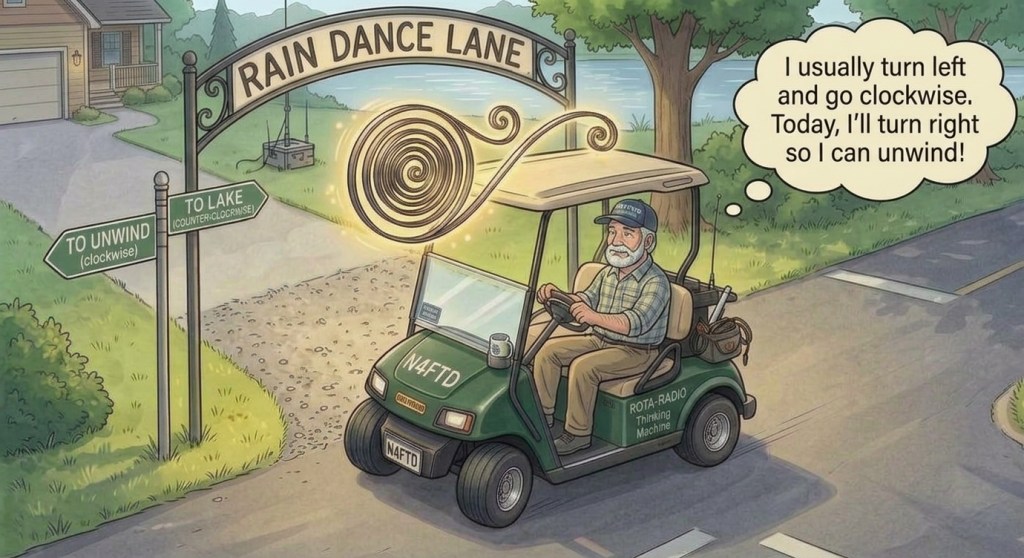
My recent routine has been to get up early, put on my headlamp and reflective vest, and head down my driveway in the dark. At the end of the driveway I turn left on Rain Dance Lane to begin my counter-clockwise trek around the perimeter of Lake Arrowhead Village. It’s a circle walk of about 1 mile.
When I get back I begin my wife’s breakfast so it’s ready when my smartphone alarm rings to say it’s time for our morning meds.
After breakfast, Sue settles in with The Today Show and I jump on the golf cart. Like my earlier trek on foot, when I get to Rain Dance Lane (RDL) I stop, turn left, and begin making my way to the western shore of Lake Arrowhead, right behind the Clubhouse.
Well, one morning recently I was in a hurry to get to the lake because timing was right to watch the sunrise over the houses on the east side of the lake. So, instead of going counter-clockwise I turned right and went clockwise for a change. Getting to the lake that way is a tiny bit shorter.
The timing was perfect, and my neighbor Clark met me going “the wrong way” as he stopped his e-bike to say hello. Because I was going the wrong way he also asked, “Why are you going the wrong way this morning? I usually sneak up behind you as you walk around the neighborhood counter-clockwise!”
For some reason I was on my toes that morning and, without hesitation, I replied:
“Well, I’ve been going counter-clockwise so long and my schedule has been so busy with my legal project that I’m all wound up like a spring. Going this way helps me ‘unwind’!”
That got a laugh from Clark, a grin from me, and we parted ways with a “see ‘ya later, pal!” I needed to get to the lake before I missed the sunrise. It was a beautiful one.
Little did I know that turning right to unwind would set my mind on a completely different loop—one that spans 50 years of radio, 20 years of teaching, and the modern IP networks running through my home.
Thinking Again!
After the sun was up in the sky far enough that I decided to move to my second-favorite spot, the field under my shade tree, I parked and sipped coffee while a new thought cropped into my head.
IT Manager or Ham Operator: A Forum Debate
I had been reading a debate thread online, something I rarely do. The forum thread was an online discussion where traditional “RF purists” were airing their grievances about the shifting landscape of ham radio. The thread was centered on how modern amateur radio hamfests, club meetings, and forum threads seem to be turning into computer science and network engineering seminars. Traditionalists were complaining that today’s radio operator looks and acts more like a system administrator than a traditional ham. They argued that when you spend your time managing microcontrollers, configuring local subnets, routing audio over IP, and setting up WireGuard VPN tunnels, you aren’t really doing “radio” anymore—you’re just doing IT work.
When I began in 1970, getting on the air meant twisting knobs, peaking drive, dipping the final, and flipping switches on an actual analog radio. Back then, we were stuck mostly in the shack because of the power requirements of tube-type radios. I got the impression that the RF Purists in this modern day forum debate came from the same roots as me.
I chuckled at the critique and admitted that the traditionalists actually had a point—especially in my case, since I literally served as a part-time IT manager after retiring as a classroom teacher during the beginning of the COVID years. For four years I helped our school manage the challenges of “remote teaching and learning” while everyone was at home. The first year we all stayed home.
Then, the second year we morphed into a “hybrid model” with some kids at home, checking in on Zoom, and the others wearing masks along with their teacher in the physical classroom.
I had practiced asynchronous instruction using videos, email, and eventually Google Classroom for a decade prior to the March-May, 2020 fourth quarter when everyone was ordered to go home and “check in with your teacher using Google Classroom, text messages, and, eventually, Zoom lessons.” Essentially, our teachers made many 5-7 minute mini-lessons that they delivered asynchronously using the learning platform we came to know and love—Google Classroom.
It’s no wonder I was open to asynchronous communications—I had been using it since I got my first AOL account, email, and later, GMAIL. Today, all of that is ubiquitous, along with plenty of other “tools”, in the non-ham world that pretty much relies upon the Internet for everything. That’s the world we live in.
Back in 2010 in my own fifth grade classroom with 20-25 students who participated with me in a “Netbook Pilot Program”—then, fast-forward to 2020 when we all had to go home to teach and learn—learning to manage remote subnets and network infrastructure wasn’t just an administrative chore; it turned out to be the exact skill set that later enabled my current station architecture.
Along the way, hams figured out how to use computer hardware and software to “define” the traditional radio components—inductors, capacitors, and more—and make the RF encodable and decodable using just software.
Now, it’s only a step further to hook up that radio—either a straight SDR or a hybrid like my IC-7300Mk2, or even a traditional radio from the “good old days” that has no computers or chips inside—to a computer and, eventually, a network.
From there, it’s one more step to use the Internet to bridge my IC-7300 in the shack to my laptop on the golf cart sitting on the western shore of Lake Arrowhead.
Can you guess how I came out on that radio vs IT manager debate?
Setting up local IP routing, Cat6 connections, and software control isn’t a betrayal of RF—it’s what lets me run my HF station from my recliner, keeping me fully present in the living room as Sue’s 24/7 caregiver while still keeping my license active on the air.
IP networking is not a replacement for raw RF. It’s the modern “control cable” that bridges the shack and the rest of my home, my neighborhood, and even the homes of my family members. I can sit in the recliner at my grandkids’ house and check in with my CDM Buddy Mark in Texas, all while watching TV with my granddaughter while her brothers are away at a concert with their mom.
The False Dichotomy: “Both-And” vs. “Either-Or”
I’ve always been interested in aiming for win-win wherever possible. It sure beats I win – you lose. Or the worst case: YOU win, I lose!
Therefore, I reject the notion that I must choose a side in the purist vs. modern networker debate. A modern control operator can—and often must—be both.
I have deep respect for the RF Pure: The joy of copper, wire, propagation, and raw RF remains the core engine for everything I do in amateur radio. IP doesn’t replace the ionosphere; it simply reaches it.
I see my IT Identity as Service: Just as managing remote learning in 2020 served the kids and teachers, managing a local subnet in 2026 serves the radio station and my home. Setting up subnets and local tunnels is just building a better control cable so I can operate my radio from anywhere. That gives me the option of sitting in the living room recliner while Sue is in the same space with me. Or, if I need a break, I can jump on my Thinking Machine (golf cart) and operate from the western banks of Lake Arrowhead.
The Control Operator Retains the Key
Human agency is at the center of this whole debate. Whether I’m turning the VFO knob on my IC-7300 directly, driving it through SDR-Control software on my Mac over local Cat6, or even operating over the Internet from “the lake”, the human operator holds the license, makes the decisions, and feels the thrill of the contact. And, that’s a big part of this debate, too. “Feeling the thrill”. This hobby of ours is supposed to be fun!
I happen to enjoy more than one hobby. My first was ham radio using CW. My second, maybe 15 years later, was computer tinkering. Now, I happily mingle the two because either-or thinking was never my cup of tea. I’m a both-and kinda guy.
Being the IT manager of my own QTH isn’t a surrender to the internet age—it’s the thoughtful, deliberate stewardship of my station, keeping RF alive on the bands and my human presence alive in our home.
Have a thought, question, or story to share?
Feel free to leave a comment below for the community, or drop me a private note at my feedback address if you’d prefer to ragchew one-on-one.
73, Paul | N4FTD | recliners.on.the.air@gmail.com
“Radio is better in the recliner, no matter where you park it!”


Leave a Reply