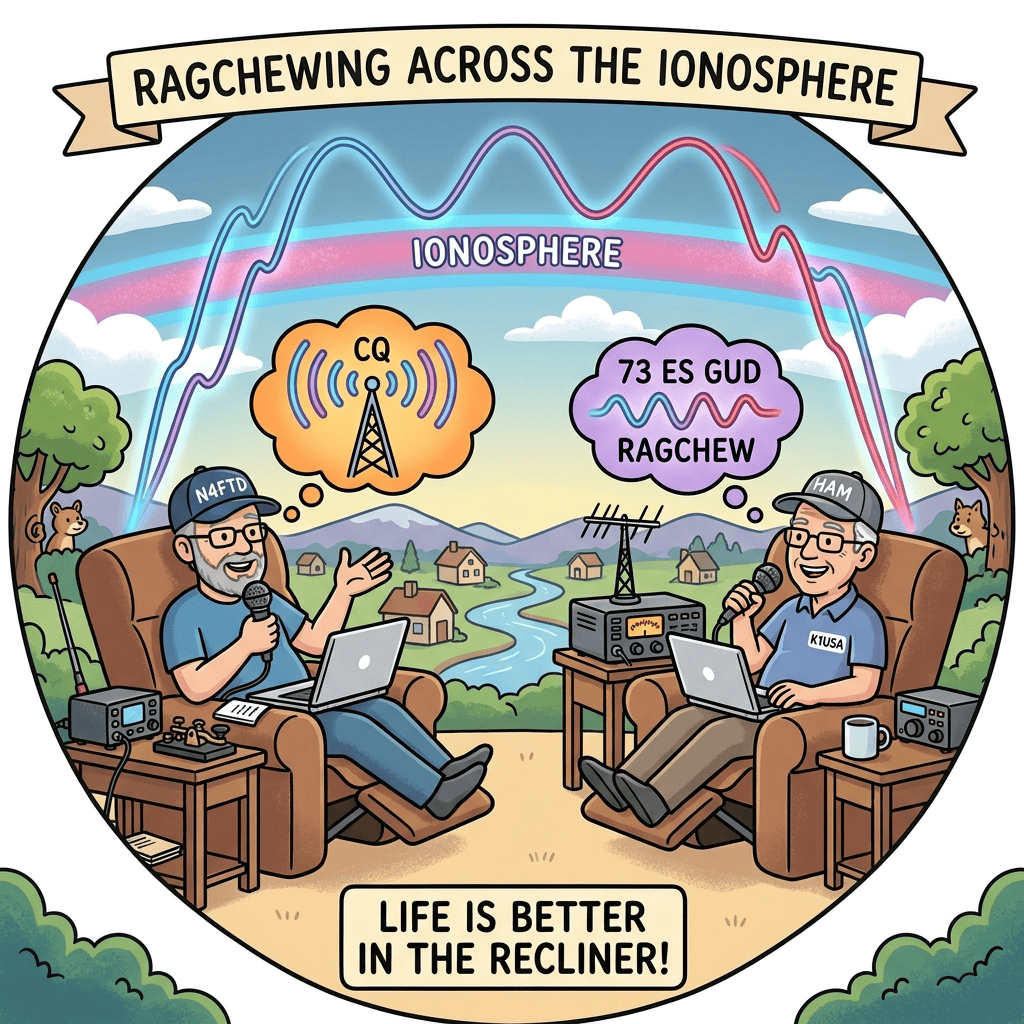
It’s Time To Bring Back An Old-Fashioned Ragchew QSO
Last week I mentioned that I like to ragchew. That got me thinking—I’m always thinking—about the word “ragchew”. So I looked it up. I’ve been looking things up ever since grade four when my teacher invited a guest to our classroom. The guest recruited all of my fellow students and me to join the Look It Up Club. Naturally, we received lots of doo-dads including a dictionary, a pen, and a special pin with Look It Up! written on the front. I digress…
According to a quick Google (AI) search on how the digital world defines it:
In amateur radio, a ragchew or ragchew QSO refers to a long, casual, and informal on-air conversation between radio operators. [contact, including ragchew contacts]
The term is the ham radio equivalent of “chewing the fat” or “chewing the rag,” which means chatting or gossiping casually. [ragchewing: lost art]
Core Characteristics of a Ragchew
- The Opposite of a Quick Contact: In standard radio operations or competitions (contesting), a QSO (the amateur radio Q-code for a contact) is often incredibly brief. Operators might only exchange call signs, location identifiers, and signal strength reports before moving on. A ragchew explicitly avoids this “59, goodbye” format. [Are you a ragchewer?]
- Varied Topics: Instead of just talking about technical specs, a ragchew involves two or more operators discussing their personal lives, families, weather, hobbies, current news, or stories about the history of the radio hobby itself.
- Duration: While there is no official timer, a traditional benchmark for a true ragchew is a conversation that lasts 30 minutes or longer. In fact, historic organizations like the ARRL historically issued a “Rag Chewers Club” (RCC) certificate to any operator who could prove they sustained an on-air conversation for at least a half-hour. [SKCC Ragchewer Award, 2]
Whether conducted over voice (phone) or through Morse code (CW), a ragchew is considered a vital social and recreational cornerstone of the amateur radio community. [How to ragchew on CW]
Bring Back the Rag Chewers Club!
Reading through those search results, I was struck by how many of them mentioned the RCC—the Rag Chewers Club—which I originally joined as a 15-year-old ham back in 1970 or 1971. I’ve been ragchewing ever since!
Don’t get me wrong. As I type this, I’m listening on 20M CW to some very short contacts being made. I’m hearing CQ RG (I had to look that one up: It’s the RandomGram CW Contest) and CQ POTA. I even “hunted” a couple of Activators and popped them into the PoLo app on my iPhone. They took about 30-45 seconds each to get into my log.
That said, those kinds of contacts are good if you’re into notches on your belt, checking your antenna and/or propagation, or some quick and easy CW practice. Me? I’m more interested in going beyond the quick and easy when I have more than 15 minutes to spare for on-air activities. [Disclaimer: I squeezed those two contacts in while eating my breakfast this morning! Not a good time for a ragchew, but a quick bit of hunting with my keyer right there next to my coffee? Couldn’t resist!]
Scheduled Ragchew QSOs
Before my wife’s needs changed I had several skeds (pre-arranged schedules where we met at a particular time on a specified frequency) with three different CW Code Buddies with whom I would chat for upwards of an hour twice a week, each. As you can imagine, we soon moved beyond RST, QTH, Name, Rig, WX, 73 formulaic QSOs.
I soon learned that not every ham operator wants to have a ragchew QSO. That’s fine. I do, and I’ve found it very easy to drum up business. Unlike 50 years ago when I just called CQ until someone answered, things are much easier today. Twenty-five percent into the 21st Century, there’s no shortage of online methods for finding like-minded operators who want to have an honest to goodness chat, maybe while relaxing in the recliner using a remote transceiver—anywhere from 15, 30 or even 60 minutes of rambling conversation on topics that often stretch beyond ham radio and related technical topics. Some even enjoy setting up a regular schedule of operating times when two or more like-minded operators get together on a regular basis.
Imagine chatting with a friend whose voice you’ve never heard (discounting maybe one or two chats on the telephone to set things up) using CW (Morse Code) at 15-20 words per minute to ragchew for an hour or more. One such friend, Scott, lives near a bayou in Louisiana; it’s right in his backyard! We’ve discussed his alligator friends, how he takes a small jon boat into the reeds to slowly wrangle them to shore where he uses a tractor to pull the mess out of the water. Other days, we talked about the large garden he plowed and prepared for his wife who works in it every day. As we got to know each other, we also improved our CW speed and accuracy. He was one of my first code buddies when I was working with CWI—CW Innovations—as a student and later as a coach.
Another friend, whom I call Mark in Texas, is a partner of mine on a project sponsored by my neighborhood CERT Team. We both joined a Groups.io group called North Texas NVIS Net. That’s where we met initially. We soon found ourselves like “two birds of a feather”, flocking away from SSB as a primary means of communicating “health and welfare” (H&W) traffic and toward digital modes like Winlink and VarAC for our Community Disaster Messenger program here in my neighborhood. Mark is my remote contact who stands ready to relay H&W messages if we ever lose commercial power and communications for an extended period of time.

Mark and I have spent literally hours, often several in the same day, chatting back and forth—usually using asynchronous methods like VarAC, Winlink, or even Internet e-mail—with the goal of building, testing, and modifying our CDM program. Naturally, and I mean that literally, we slowly gravitated toward mini-discussions about each other’s backgrounds, careers, families and our personal lives. I always come away from these conversations feeling fulfilled and energized.
These examples illustrate just a few of my ragchew friends and what we share together on the airwaves. Our relationships have gone the gamut from just blabbing about our workbench projects, to sharing about our family and work lives, and even to collaborating on community service projects together, plus everything in-between.
If you’re not a talker, maybe you don’t even enjoy getting on the air. Maybe you’re a builder, and only plug your radio creations into a dummy load to make sure they work before moving on to the next project. Those are just a couple of the “1000 Hobbies” that reside within the circus we know as Amateur (or Ham) Radio. It’s all good, it’s all fun. There’s plenty for all of us to enjoy.
Me? You’ll find me on the air when I’m playing radio. Just like when I was a kid in the 70s, today I still do more listening than talking. Sometimes, I just have to jump in with my callsign and add to the circus. That’s what it’s all about!
What about you? Where do you fall in the spectrum of operators? Ragchewer? Or, something else? Jump in and share!
Have a thought, question, or story to share?
Feel free to leave a comment below for the community, or drop me a private note at my feedback address if you’d prefer to ragchew one-on-one.
73, Paul | N4FTD | recliners.on.the.air@gmail.com
“Radio is better in the recliner, no matter where you park it!”


Leave a comment