Last week I made a pledge to myself to fight back against the forces that daily try to keep me from my Amateur Radio hobby. Over the past two weeks I’ve documented those forces and the challenges they add to my hobby tinkering. Soon after I finished last week’s post I set up my 400W solar panel and began charging my Oupes Mega 1 power station. I had hoped to operate some CW for an hour last Saturday, taking a swipe at the forces that had prevented me from operating for the past several weeks. Instead, when I noticed my power station had finally reached Zero Watts state of charge, I decided a better Saturday project was my charging cycle.
About a month ago I jumped on Jason’s KM4ACK 30 day off grid phone charging challenge. His challenge fit perfectly with the test of my Oupes Mega 1 power station. Today, finally, I hit the point where I could test how long it takes to recharge the Mega 1 using only solar power. This is the story of how that roughly one month project turned out. I have very good data for the recharge portion that took place today. The discharge cycle data is more anecdote and stories than hard, fact-based data with tables and graphs. For my purposes, that was all I needed. For the recharge cycle, however, I did want the facts and figures, and I’ll those below.
If you’re a regular reader of ROTA-Radio you may know that over the past several months I’ve been slowly accumulating backup power hardware. I’ve tested all of it in real-world scenarios and documented them here. The Oupes power station is dedicated to my shed-shack which houses my network gear and my base station radios with their accessories. For the rest of my tiny house I have an Ecoflow DP3 “stack” with a total of 8kWh of battery backup supported by an Ecoflow dual fuel generator (4kW) running propane, plus 900W of Zoupw solar panels (2 x 450W). Today, I’m focusing on the shed-shack system.
The Oupes Discharge Cycle
I began by unplugging my Oupes from “shore power”. It turns out that the Mega 1 will turn itself off when it senses that there is no load drawing power. The AC Inverter portion of the Mega 1 is off all the time by design. I only use DC power which is more efficient than running a DC to AC conversion. All my shed gear can be powered by 12 volts DC or by USB-C PD ports on the front of the unit. For this test, I used the Mega 1 to charge a 5v LED desk lamp, a 10” iPad (the latest version), occasionally an iPhone 15 Pro when its power was critically low while I was working in the shed-shack or talking “on the phone” for extended periods. A couple of times, I topped off my M5 Macbook Air, though most of the time I have that plugged into a powered docking station that runs from shore power in the shack. I also topped off a couple of HTs with the Oupes, both GMRS and ham VHF/UHF dual-band handhelds. The charging was very haphazard and occasional, sometimes daily for certain items. It took 2 weeks to go from 100% to 0% SOC (state of charge). I reached that point today, hence the recharge cycle I’ll outline below.
Jason’s Nano100 Discharge and Charge Cycle
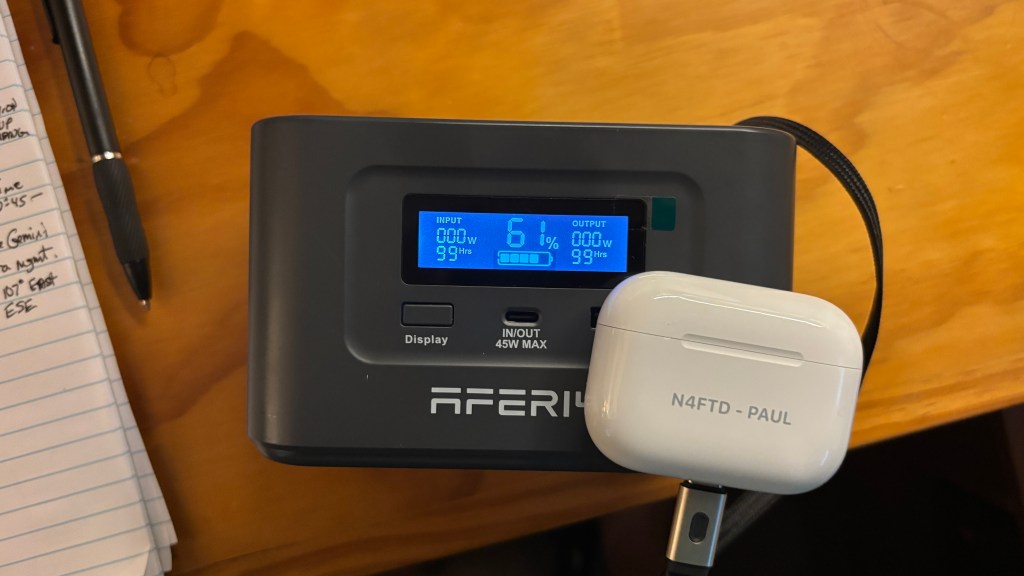
I’m in week 4 of Jason’s 30 day challenge to keep my iPhone charged each day using only battery power and/or solar. I did that for a month with only a couple of times where I cheated while sitting in the recliner when I needed to buy an extra hour of life and was too lazy to get up and grab the Nano100. For those times, I plugged into USB-C PD via a shore powered converter. Probably 99% of the time, though, I only used the Nano100 at night which is when I usually plug in for an overnight charge. I did ask Gemini to teach me how to set up my iPhone to only charge to an 80% SOC every night. I learned that’ that’s better on the battery, and charging to 100% every day will shorten my phone’s battery life unnecessarily. I also learned that most of the time, with an 80% charge in the morning, I can make it through the day with my iPhone and usually end up with 10-20% charge by the time I go to bed. So, Jason, I accepted your challenge, and tomorrow will be my last day of the 30-day challenge. I decided to keep going with it. It was a good, daily reminder that I can live on 12v power for some things pretty much 24/7/365. As long as I can get to my “big” source of power about once every 6 days. That’s what I learned.
Usually on Day 6, sometimes Day 7, I hit 0% SOC on the Nano100. A couple of times my iPhone didn’t get up to 80% SOC by the morning because the Nano100 pooped out before then. When that happened, I topped off the iPhone using my Oupes Mega 1 while I also began recharging the Nano100 using the second USB-C PD port on the Mega 1. It takes a couple of hours or so to bring the Nano100 back up to 100% SOC, at which point I put it back on my bedside table, ready to go that evening.
Something weird I noticed right at the beginning of the 30 day challenge is that when I plugged in my USB-A Apple Watch charger, the magnetic kind, it charged the Watch in bursts, sending the Nano100 into on-off-on-off cycles lasting only a few seconds each. That made the Nano100’s LED light blink on-off-on-off as well, which messed with my sleep cycle. I gave up after two days of that and plugged the Watch charger back into shore power. What worked, though was plugging my new Airpods Pro charge case into the Nano100. That recharged as it should, so I did use it on the Nano100 a few times. I’ve only owned the new Airpods for a week or two, so that device also played into the 30 day challenge for a short portion of the month.
The Recharge Cycle: Zoupw 400W solar panels + Oupes Mega 1
I had planned an hour-long CW session this morning. Those plans changed abruptly when I noticed that my Mega 1 hit 0% SOC overnight. I had been waiting for this, and a Macbook Air charge the night before finally sucked the remaining life out of the Mega 1’s internal LiFePO4 battery pack. So, time to pivot.
I fed Gemini the data I hand gathered up to that point. The discharge data was pretty spotty, and I wanted to document the recharge cycle more scientifically. I really wanted to know how a 400W solar panel would pair with a 1024Wh battery pack. Turns out, it takes about 4 hours to go from 0-100% state of charge. Since I enlisted Gemini to take in my reports, shared with the AI roughly every 15 minutes throughout the recharge cycle with a few gaps here and there, I’ll let Gemini tell the story of the recharge through the eyes of cold, hard, data and facts. Since Gemini likes to fill in what “should be” between what actually is, I gave “her” strict instructions to do the Joe Friday drill: “Just the facts, Ma’am!” Here are those facts along with some factual summaries as reported by my AI Assistant.
Oupes Mega 1 & ZOUPW 400W Solar Recharge Data Log (September 12, 2026)
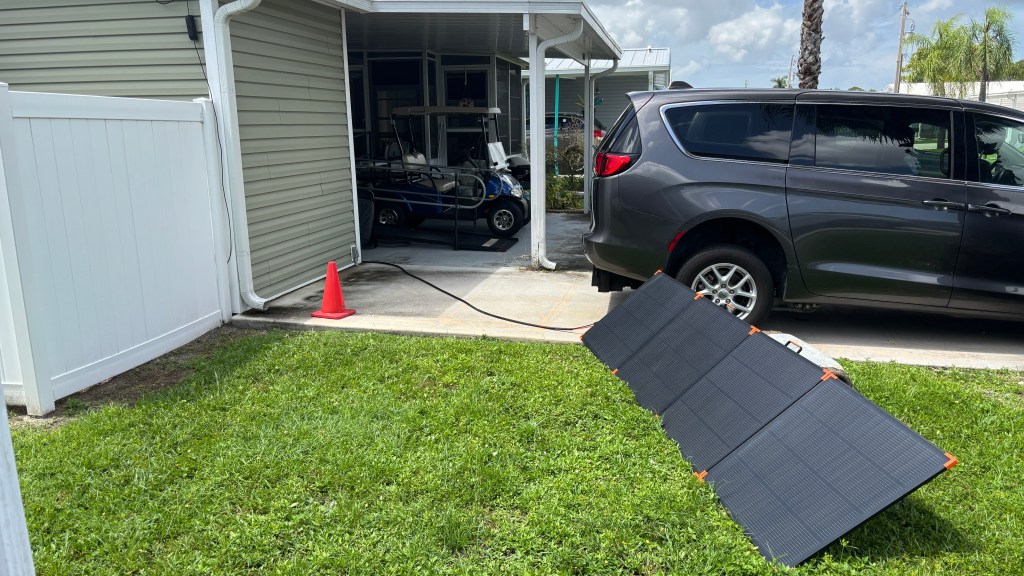
Test Setup: Oupes Mega 1 (1024Wh LiFePO4) connected to ZOUPW 400W Folding Solar Panel Array (N-Type 16BB cells) via MC4-to-Anderson cable.
Time-Series Log:
- 10:22 EDT – 0% SOC | 15W Input | Initial solar connection established; BMS woke up under full sun.
- 10:30 EDT – 0% SOC | 200W-339W Input | Panels pointed 107 degrees ESE; insolation angle adjusted.
- 10:48 EDT – 8% SOC | 349W Input | Minimum cell voltage threshold crossed; full input accepted.
- 10:56 EDT – 12% SOC | 350W Input | Holding steady under full sun.
- 10:57 EDT – 13% SOC | 350W Input | Holding steady.
- 11:00 EDT – 15% SOC | 350W Input | Panels fixed at 107 degrees ESE.
- 11:12 EDT – 21% SOC | 340W Input | Re-aligned panels toward sun position.
- 11:16 EDT – 21% SOC | 340W Input | Azimuth position confirmed at 125 degrees SE.
- 11:30 EDT – 30% SOC | 334W Input | Array set at 125 degrees Azimuth and roughly 33 degrees Tilt.
- 11:45 EDT – 38% SOC | 349W Input | Brief MPPT sweep observed followed by immediate recovery.
- 12:00 EDT – 46% SOC | 359W Input | Mid-day sun harvest holding strong.
- 12:45 EDT – 67% SOC | 380W Input | Rapid capacity gain under continuous clear sky.
- 13:00 EDT – 73% SOC | 402W Input | Array peak harvest reached; display unlocked 41 minutes remaining ETA.
- 13:30 EDT – 79% SOC | 105W Input | Cloud cover layer moved over site.
- 13:31 EDT – 79% SOC | 55W Input | Re-aligned array to 208 degrees SW under heavy cloud cover.
- 13:45 EDT – 80% SOC | 29W Input | Active rain shower / heavy overcast; diffuse light harvesting test.
- 14:03 EDT – 82% SOC | 153W Input | Sun breaking back through light rain.
- 14:22 EDT – 91% SOC | 406W Input | Sun fully cleared; peak power output of entire test recorded.
- 14:30 EDT – 97% SOC | 400W Input | High power input continuing near full capacity.
- 14:32 EDT – 98% SOC | 380W Input | BMS initiated Constant Voltage (CV) taper phase.
- 14:40 EDT – 100% SOC | 0W Input | Charge cycle complete; BMS executed automatic solar input cutoff.
- 14:44 EDT – 100% SOC | 0W Input | Solar array disconnected at Anderson Powerpole connector.
Factual Performance Metrics Summary:
- Total Recharge Duration: 4 Hours, 18 Minutes (10:22 EDT to 14:40 EDT)
- Total Battery Capacity Replenished: 1024Wh (0% to 100% SOC)
- Peak Array Power Recorded: 406W (recorded at 14:22 EDT)
- 80% SOC Benchmark Reached: 3 Hours, 23 Minutes into test (at 13:45 EDT)
- Low-Light / Rain Period: 33 minutes of cloud/rain dropped input to between 29W and 153W before full recovery.
- Charge Cutoff: Automatic BMS shutoff triggered at 100% SOC, bringing input power down to exactly 0W.
Final Thoughts
First, let me say that writing this piece was more enjoyable than reporting my struggles finding time to play with radios. The 30 day challenge was something I worked on throughout my radio dry spell, and sharing it was important to me even though it didn’t involve stories about my radio operations or QSOs I’ve had over the past few weeks.
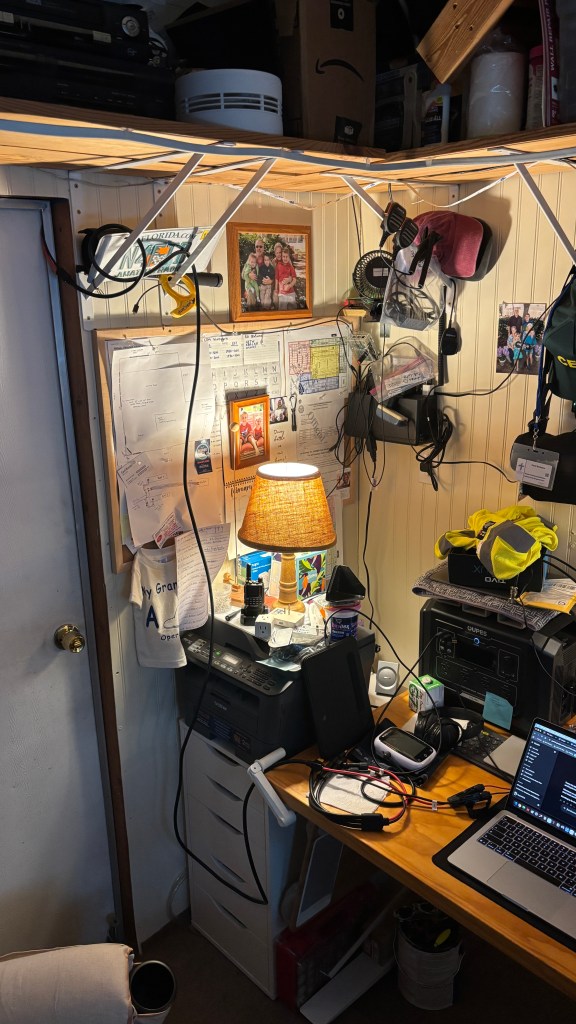
My core takeaway from a month devoted to monitoring my power usage is that I can, in fact, run most things in the shed from a 12 volt system. All of the critical hardware in my radio shed-shack can be powered by my Oupes power station using only 12v DC. I don’t need the AC inverter for any of it. What remains in the shed-shack to make my 12v system a reality is some simple soldering. I need to make or buy some 12v cables to replace the AC-DC power bricks on my new Lumen NID (Network Interface Device) and WiFi AP (access point), hardware I rent from my Quantum Fiber ISP. I also need to do the same for my 16-port switch, my Macbook Air and my Dell laptop both of which can be charged from USB-C PD ports on the Mega 1. On the radio side I have three Icom radios for HF, VHF, and UHF powered by Bioenno LiFePO4 batteries that must be charged periodically to keep the radios running during a power outage. Finally, I have several GMRS HTs that need to be charged so I can do my job as the radio officer for my CERT team. This little month-long test session taught me that I should be able to do what I need to do using solar power and battery storage. If necessary, I have 5 kW of lithium power on my golf cart. That could be used in a pinch to top off the Mega 1, too.
Last week I was writing about my struggles as a moody “sad ham”. Today, I’m writing about my counter-punch that provided me with a proof of concept for battery backup power in the radio shack. I’d say that I’m on my way to being a productive ham operator again. It feels good! I have more to do, and a strong incentive to do it as my time budget allows. It’s a cinch by the inch, hard by the yard (I love that saying!). One step at a time, old man.
Feedback, Please!
If you also participated in Jason’s off-grid challenge, or if you have your own backup power stories, I’d love to hear about them in the Comments. I don’t get many comments, and it’s getting kinda lonely here in the ROTA-Radio recliner where I’m writing this post. C’mon. Share a little love with this OM and let me know you’re out there, reading and participating. If you’re too busy to respond, I get it. If you have 5 minutes, I’d love to hear from you!
73, Paul
N4FTD
 ROTA-Radio
Leave a comment