It started under perfectly blue skies.
This morning, exactly two minutes before “net time,” the grid in my North Fort Myers neighborhood vanished. As the Net Control Station for our local Community Emergency Response Team (CERT), I didn’t have time to worry about the sudden silence of my ceiling fan. I fired up my battery-powered radio and ran the weekly net right on schedule.
As my neighbors checked in, I polled each of them: “Do you have power right now?”
The unanimous answer? Yes. Every one of the CERT check-ins had electricity except me.
While my three APC UPS units kept the internet alive, the indoor temperature began to climb. Within five minutes, I was sweating. And if you know me, you know I absolutely hate to sweat.
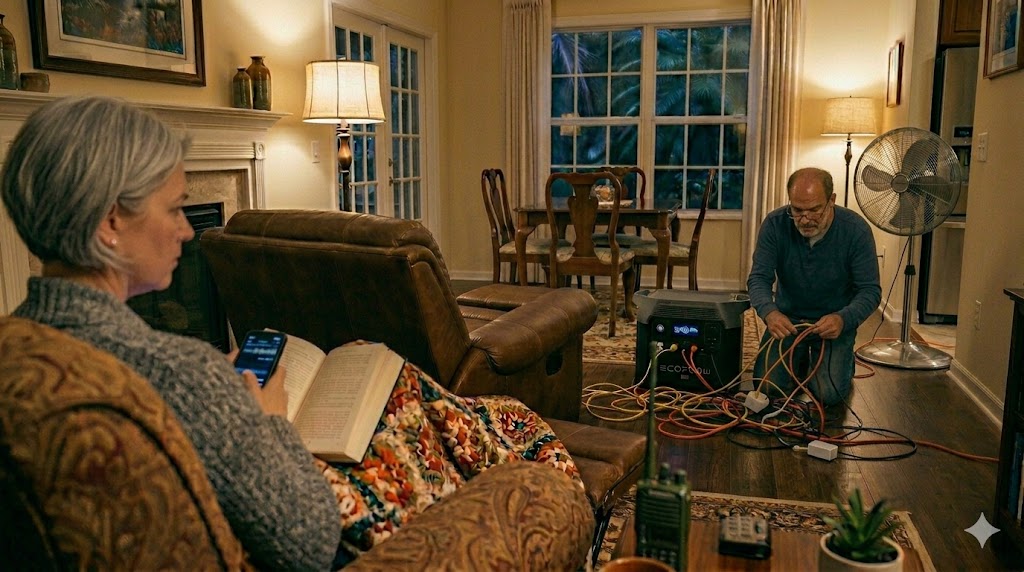
The moment the net concluded, I logged into the power company’s portal to find 126 localized outages reported, with a four-hour estimated restoration time. I immediately sprang into action, rolling my EcoFlow Delta Pro 3 out of the closet and plugging in the refrigerator. I grabbed an extension cord and was just about to run a fan into the living room when—just as suddenly as it had dropped—the grid snapped back to life.
It lasted less than a half-hour. But it was exactly the kind of unexpected wake-up call I needed to brutally audit my grid-down survival plan as we approach the peak of the 2026 hurricane season.
From FUNCOMM to Real-World Realities
If you follow this blog, you know that 99% of my time is spent on “FUNCOMM”—the pure hobby side of amateur radio. I love nothing more than sitting in my recliner on my new M5 MacBook Air, practicing digital data logging with Winlink, or configuring network links.
In the past few years, my ham radio mantra changed. Today, I follow this action plan: FUNCOMM stops when the emergency begins.
Ever since my wife Sue’s mobility took a serious turn for the worse just over a year ago, my perspective on emergency management has completely shifted. As her sole caregiver, everything takes longer now—evacuating before a storm makes landfall, securing the house, and transitioning back home after the dust settles.
When Hurricane Ian put us at ground zero a few years back, we faced a brutal two-week outage. I’ve spent months building my current backup plan around surviving another two-week grid collapse. But today’s blue-sky “blip” reminded me of a classic rule: Life is what happens when you’re busy making other plans.
I was preparing for a hurricane scenario where we get a week’s notice. “Life” handed me a sudden blackout with zero warning. It forced me to realize that trying to scramble in a hot, humid house to string extension cords to the EcoFlow DP3 isn’t just annoying—it’s a point of failure when managing caregiving duties.
To keep my cool—literally and metaphorically—I need an automated, easy-to-deploy system. Here are the five facts I am facing down on my calendar this July to turn this setup into a seamless, 30-minute deployment sans extension cords.
The July Resiliency Action Plan
1. Call the Electrician for a Transfer Switch
I originally thought I could get by running extension cords into the living space for the DP3. Ten minutes of scrambling this morning proved me wrong. I’m hiring an electrician to install a manual transfer switch and a 220V power inlet. When the grid drops, I want to flip a single switch and backfeed the house directly from the EcoFlow.
2. Isolate Essential Circuits
I’m working with the electrician to map out a strict, minimalist load profile. When the house is on backup power, only critical infrastructure stays live: the refrigerator, a few essential outlets, the internet gateway, and the living room ceiling fan. Everything else stays dead to preserve runtime.
3. Deploy the “Cool Air Box”
Fortunately, Sue’s hospital bed is set up in our living room, which will serve as our primary command center if we hunker down. I’ve already sized out a dedicated window A/C unit tailored to the room’s volume and the DP3’s output capacity.
- The Strategy: I’m keeping the unit packed away in the shed with pre-cut foam window inserts. The window stays locked tight during high winds. After the storm passes and we return from evacuation, I can drop the A/C into the frame in minutes.
- Last Minute Update: Writing this article got me moving. I just pressed “Order” in the Amazon cart. The unit will arrive tomorrow!
4. Execute a Full-Load Thermal Test
I have 900 watts of solar panels and the EcoFlow Dual Fuel Smart Generator ready to go. This July, when Southwest Florida daytime temperatures hit the 90s and grid demand peaks, I am pulling the plug on purpose. I’ll run our essential circuits under peak thermal load to benchmark exactly how the system handles real-world stress. (Note to self: Have the electrician punch two clean utility holes in the wall for the heavy DC solar and generator lines to pass safely inside).
5. Double the Capacity (Adding the Brawn)
The DP3 carries the “brains,” but I need more raw runtime to hit a sustainable 24-hour cycle. I’m adding the supplemental expansion battery, which sits directly on top of the main unit and doubles our footprint from 4 kWh to 8 kWh. My ultimate goal is a balanced ecosystem: running silently on solar and battery, with a tight 1-to-1.5 hour generator run window each day to top off the cells.
The Ultimate Goal
During Hurricane Ian, I had a 21-foot camper van that served as a self-contained, air-conditioned escape pod, providing 12.8 kWh of silent power to my grandkids’ house. That rolling powerhouse is gone now. The battlefield has shifted to the house itself, and the priorities remain absolute: power, communications, food, and water.
All the practice I do with digital data compression from the comfort of the recliner gives me the mental bandwidth to handle communications under stress. But physical comfort is just as vital to survival.
The best-case scenario for Hurricane Season 2026? I spend the money, the electrician tightens the last screw on the transfer switch, the solar panels sit waiting, and we never have to use any of it. But if the grid drops out for real, we will be ready to flip the switch, keep the air moving, and handle the mission without breaking a sweat.
73,
Paul, N4FTD


Leave a comment