The Move to the “Adventure”
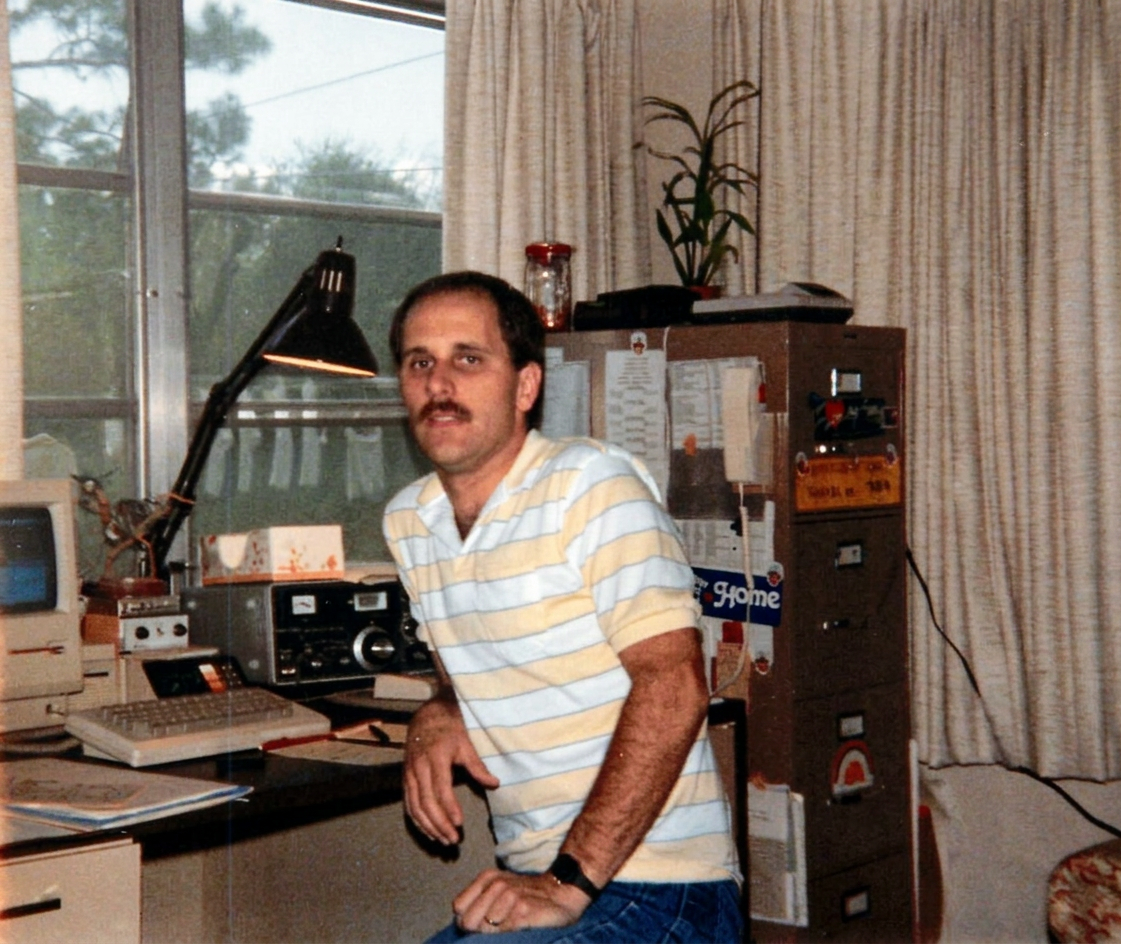
In 1984, our “nuclear family” of three made a pivot that would define the next decade. We moved from the familiar comforts of Lakeland to East-Central Florida. It was a move necessitated by my career path in church-based education, but for my ham radio journey, it was like moving into a high-voltage laboratory.
While Lakeland was about the “foundation,” Deltona and the surrounding East-Central Florida area were about the Adventure. This was the era of the 15-year “80s,” a time when I learned that “Height is Might” for VHF and beyond, and that the most powerful connection isn’t always through the ionosphere—sometimes, it’s across the street.
Front Row Seats to History
Living only 30 miles from Launch Pads 39A and 39B at Kennedy Space Center, I had a front-row seat to the U.S. Space Program. This was the era of the Shuttle, and for a tech-minded ham, the experience was visceral.
I would stand in my front yard and watch the pillars of fire lift those massive orbiters into the Florida sky. But the “tech thrill” wasn’t just visual. I would have my VHF radio tuned to a local repeater that simulcast the launch audio. Hearing the “Go for Throttle Up” through my own radio equipment while watching the physical reality of the launch was a synergy of hobby and history I’ll never forget. It’s a connection that came full circle years later when I had the privilege of taking my fifth-grade classes to “Space Camp” at KSC, sleeping in sleeping bags under the Saturn V and later the Shuttle Atlantis every year for 17 years in a row.
The Digital Frontier: Node-Hopping and Asynchronicity
The 80s and early 90s were when I began marrying computer technology with RF. I dived headfirst into VHF Packet Radio.
In an era before everyone had an email address in their pocket, Packet Radio felt like magic. I became obsessed with “node-hopping”—linking my radio through various remote stations just to see how far I could go to connect with a remote BBS (Bulletin Board System) or a digital mailbox.
This was my first introduction to the power of asynchronous communication. I realized I could send a five-page file of text more efficiently than I could read it aloud over a voice channel. I could leave a message and have it wait for a friend hours or days later. It was the precursor to the VARAC and Winlink workflows I use today—the “slow learner” was finally starting to master the “how” and the “why” of digital traffic.
Eyeball QSOs and 30-Year Friendships
Perhaps the greatest reward of this decade was moving from “voices in the static” to “Eyeball QSOs.” My community wasn’t just a list of callsigns anymore; it was a band of brothers and sisters.
I think of Gordon KY6V (SK), a retired CBS radio/TV engineer who became a mentor and a lifelong friend. He never knew a stranger. Rest in peace, my friend. Or Roger “The Chief” W4RFJ, whom I first met via Echolink while he was still living in PA and who eventually hosted me in his Florida driveway decades later during my RV travels.
We used every tool available to stay connected: VHF simplex in the evenings, 1400-foot “super repeaters” that allowed us to talk coast-to-coast across Central Florida, and later, the early internet and Echolink. These weren’t just “radio contacts”; they were lifelines. When the work of church-based education became challenging, it was this community—and my family—that gave me the outlet and the strength to endure.
The “Used” Station
Technically, I was still the ham who “made do.” While I saw the shiny new rigs in the catalogs, my shack was powered by used gear like my Icom 2AT handheld and a Mirage amplifier. That handheld-and-amp combo served as my mobile, my base, and my lifeline for years. It wasn’t until we moved to Fort Myers in 2001 that I finally bought my first “new” radio. But looking back, that used gear taught me more about troubleshooting and persistence than a brand-new box ever could.
The “long 80s” formed the bedrock of who I am as an operator today. It taught me that while the technology changes—from packet nodes to Starlink—the heart of the hobby is the connection we make with each other.
Next Week: We look at the 90s and the transition into the modern era of education and radio.
73 – dit dit
 ROTA-Radio
Leave a comment